Note: This work product primarily focuses on Gojek’s onboarding flow, as it was the only part of the platform I had access to. It excludes broader initiatives like marketing and social media campaigns to drive growth, with a main focus on mapping actionable product development insights.
I recently listened to an episode of Lenny’s Podcast that featured Crystal Widjaja, former growth PM at Gojek. Not only was the episode a phenomenal listen, Crystal also shared one of the product case studies she typically presents to interview candidates.
Here it is:

As you can see, a lot of it was redacted, including vital data, since the case study was not shared in full. Nevertheless, I thought it was an interesting challenge for myself to sort of brush down on what I’ve previously worked on and how I think I would approach a similar growth challenge.
Setting the Stage: Gojek’s Goals
Gojek’s goals:
- Maximise the number of active users on the Gojek platform
- Increase the frequency of usage for each user on the Gojek platform
What would my approach look like to achieve the two goals above?
Step 1: Review the Onboarding Flow
Gojek positions itself as a super app. The preview on the iOS App Store highlights affordable rides (GoRide; GoCar), food deliver with “unlimited options” (GoFood), parcel delivery (GoSend), and online shopping (GoMart). Whilst I haven’t used Gojek myself, I recently returned from South Korea, where I used a similar super app like Kakao. For someone living in the Nordics, this is awesome as these services are typically spread across 3-4 separate apps.
My First Impressions

Screenshots of Gojek’s first screen and user onboarding flow
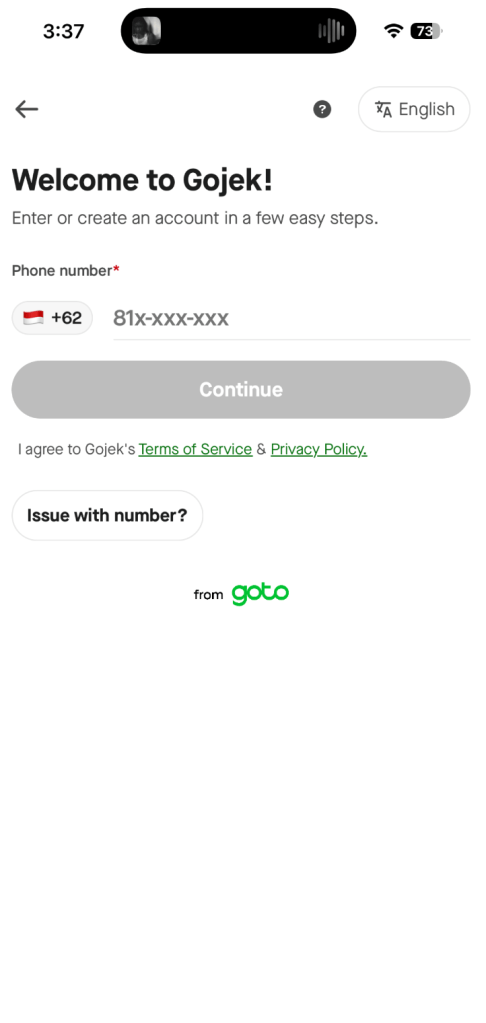
Opening the app requires creating an account, with phone verification done via an OTP sent by SMS. Sadly, since I’m based outside of Indonesia and Singapore, I was unable to get past this step. However, the app does provide helpful support context for users who encounter issues at this step, which would be interesting to analyse in more detail.
Since I couldn’t get past this hurdle, though, I referred to this excellent product review for insights into the onboarding flow.
Highlights
- Onboarding Carousel
- The app starts with an onboarding carousel, showcasing different features depending on a user’s job. Not only does the visual guide here have the potential to make the onboarding process more engaging and straightforward, it further reinforces the product’s value proposition
- Features are showcased on the carousel according to the most popular services or what’s most relevant for new users, which is based on previously collected data points
- Personalisation via Location Data
- During the onboarding, users are asked if Gojek can access their location data. This enables the app to personalise content and offer promotions and information based on a user’s unique location (aka contextual relevance)
Key Takeaways
- Gojek clearly communicates its value proposition as a super app, appealing to a wide set of users with diverse needs
- The onboarding flow is visual and simple, tailored to user jobs
- The onboarding is personalised through, for example, location-sharing
So that’s the onboarding flow in a nutshell. Where do we go from here?
Step 2: Define and Analyse the Funnel
Thought Process: A clear view of the funnel and user journey (Sign-Up → Verification → Booking → Active Users) reveals where users drop off and why, which may enable targeted improvements. As an example, based on my limited experience using Gojek, I want to analyse potential issues with the phone verification or location-sharing acceptance rates.
Approach:
- Use SQL queries or Clevertap (which I’ve never used) to extract data and calculate conversion rates
- Analyse time spent at each step and drop-off points
Why? Pinpointing friction points enables us to understand if this is a big enough problem to solve. Equally, quantifying friction highlights opportunities to streamline the onboarding flow and improves retention.
Next Step: Combine funnel data with behavioural data as well as assess operational costs and support impact of pivotal steps like phone verification.
Step 3: Understand User Behaviour
Thought Process: Patterns in user behaviour reveal the keys to scaling engagement. Active users often exhibit distinct behaviours that can inform strategies to improve early user retention. We want to, for example, compare with users who only signed up with active users.
Approach:
- Use analytics tools to track user paths, session durations, and clicks (funnel and path analysis)
- Segment users by demographics and usage trends (e.g., cohort retention analysis)
- Correlate behaviours (e.g., app usage frequency) with retention
- Use visualisations like heat maps to show which features and screens on the carousel drive user engagement
Why? Insights from user behaviour guide strategies to reduce churn and potentially foster repeated use in the long-run.
Step 4: Address Friction Points
Thought Process: Drop-offs signal that something is broken or unclear. Addressing identified pain points is key to boosting the number of active users and usage frequency for each user.
Whilst the exact details are missing from the case study, this approach is informed by similar challenges I’ve tackled in the past. With that said, what follows are some assumptions from my side. Importantly, the goal with this step is to solve tangible, data-informed problems rather than rely on assumptions.
Approach:
- Short-Term:
- Simplify OTP flow with delivery alternatives (e.g., email backups)
- A/B test onboarding copy to highlight key user benefits (e.g., convenience and reliability)
- Add contextual guidance, like step counters or onboarding checklists, to visualise progress
- Long-Term:
- Continue to clarify the value proposition through tailored onboarding carousels
- Further personalise the onboarding with relevant features based on location data or user context (e.g., if you were referred by a friend, show the user what that friend has done!)
Why? Simplifying the OTP flow with alternatives such as email backups ensures users can complete verification without delays, removing a significant barrier in the onboarding process. Adding contextual guidance, like step counters or checklists, helps users visualise their progress, reducing confusion and friction. These improvements ensure more users successfully complete onboarding, directly contributing to boosting the number of successfully onboarded users.
By further A/B testing onboarding copy to emphasise key benefits, such as convenience and reliability, ensures users immediately understand the app’s value and can help boost the number of active users. Tailored onboarding carousels that highlight relevant services based on location or context (e.g., local food options or frequent ride routes) can additionally clarify the app’s value proposition. It further directly connects users to what they value and ties it to their primary and emotional jobs.
Equally, personalising the onboarding strengthens trust and connection. For example, showing referred users what their friends have done drive home familiarity and relevance to users. This creates a stronger emotional link and encourages repeat visits, which supports Gojek’s goal to increase usage frequency for each user.
Step 5: Experimentation as a Growth Driver
Thought Process: Experiments test ideas efficiently without overcommitting resources. By analysing results, I can identify what works, scale successful solutions, and continuously refine the approach.
Approach:
- Prioritise experiments using my numeric formula (a shameless plug, I know) to focus on the highest potential ROI
- Validate results with statistical analyses, like t-tests or chi-square tests
Why? A structured and prioritised approach to experimentation ensures resources are spent on the most impactful solutions, driving continuous improvement and scalable growth.
Step 6: Measure Success
Thought Process: Metrics are more than just indicators of success; they guide future action. If you’ve read my previous posts, you know I’m all about tying stuff back to your product outcomes. This mirrors what Crystal explained in Lenny’s episode, the difference between observed facts and actionable insights is what drives meaningful product discovery. Tracking the right KPIs consistently ensures efforts align with outcomes. In other words, what gets measures gets improved.
Approach:
- Set up real-time dashboards for metrics like DAU/MAU, retention, and funnel conversion rates
- Use cohort analysis to measure the impact of interventions over time
- Focus on tracking both business outcomes (e.g., repeat bookings, revenue growth) and user activity metrics
Why? Clear and actionable metrics provide accountability and helps to narrow down development efforts. By measuring what matters, you ensure that data informs decisions to drive growth.
Final Words
This case study was a great exercise in tackling growth challenges like Gojek’s, or at least how I would approach it.
Ultimately, I believe growth isn’t just about solving problems. It’s about learning, iterating, and staying aligned with what matters to users and the business.

Leave a comment