
Executive Summary
This blog post explores how The New York Times applies Product-Led Growth (PLG) to attract, retain, and grow its audience. It looks at how the company uses freemium models, personalisation, and referrals to deliver value and drive engagement.
Setting The Stage
Product-Led Growth (PLG) isn’t just a buzzword. It’s redefining business strategies and how we look at growth. The rise of PLG is rooted in key shifts, such as the emergence of the SaaS model in the early 2010s and the increasing focus on user-centric product development. PLG puts the product at the core, driving growth through kick-ass user experiences.
Traditionally, PLG has been associated with tech companies. Renowned examples include Figma and TikTok, which are known for their viral loops and word-of-mouth growth.
In this post, however, we’ll explore how the principles of PLG are being applied by a non-tech company: The New York Times.
The PLG Model
PLG positions the product’s value proposition at the core of user acquisition and retention. By delivering user experiences that users really love, the PLG model strives to enable self-service adoption. Equally, it aims to reduce your typical costs associated with sales and marketing, relying instead on organic growth through referrals to drive user acquisition.
Imagine two key cohorts:
- Freemium users
- Paying customers
The freemium cohort is crucial for acquisition in the PLG model. As user expectations rise, they demand to experience a product’s value proposition for free before committing, which is arguably a consequence of the so-called subscription economy (Product Led Hub, 2019). In the example of The New York Times, some articles are unlocked, whilst others offer a teaser (typically a few sentences) before users hit a paywall.
Another example is Wordle, arguably my favourite from the NYT games vertical. Users can share their results online with friends and family, which sparks curiosity and invites others to join the platform naturally.
Free offerings are a powerful tool for growth. But they’re not the only tool in the box.
Metrics That Matter
The New York Times tracks metrics like total subscribers and the share of digital-only subscribers. This aligns with their business goal of 15M+ subscribers by 2027 (The New York Times, 2024). However, financial metrics only tell part of the story.
If you’re doing PLG right, it’s essential to prioritise metrics that measure retention, conversion, and customer value. The goal is to grow and expand the number of active, paying users. Given The New York Times’ exceptional product and data teams, it’s safe to assume they also measure these metrics behind the scenes.
Take the sign-up flow and subscription journey, for example. These are critical to optimising growth. Key questions include:
- How many people sign up?
- How many activate a subscription?
The focus is to track the journey from a new user to their “Aha!” moment (the point where they experience the product’s value proposition).
But PLG doesn’t stop there. Continuous onboarding is another critical element, as it ensures that users are consistently reminded of the product’s value proposition. Metrics like active users (DAUs/MAUs) or engagement indicators such as articles read per user offer insights into how well a product is delivering on its core value proposition. For The New York Times, increased user engagement creates a more personalised and meaningful experience, enhancing customer satisfaction and consequently stickiness.
Equally important is collecting user feedback. Understanding why customers cancel or fail to subscribe provides actionable insights to address pain points. A seamless and user-centered experience ensures the product aligns with customer needs. Because after all, people vote with their wallets.
Of course, it’s important to acknowledge external factors can influence growth. These may supersede metrics. The New York Times, as an example, saw a significant boost in digital-only subscribers during the Covid-19 pandemic. However, long-term success hinges on aligning metrics and staying true to the product’s core value proposition. For The New York Times, that’s journalism.
Lead Generation: Reinvented
“Funnels are dead. Loops rule.”
I have heard this statement, or variations of it, in different discussions about growth strategies. Whilst I don’t entirely agree — both funnels and loops have their place — there’s no denying the power of viral loops in PLG. Viral loops embody classic PLG strategies: there’s reduced reliance on sales and marketing teams and a shift toward users referring your product organically.
Another way to look it is that PLG reshapes the funnel. It focuses on user behaviour rather than traditional sales-driven lead generation. With PLG, the goal is to leverage analytics tools to deeply understand how users interact with your product, whether they’re freemium users or paying customers.
Key insights for The New York Times may come from:
- Reader preferences — What articles or features attract and retain users?
- Engagement — How often are users interacting with content, like articles read or crossword puzzles completed?
- Subscription intent — What behaviours signal readiness to convert from freemium to a paid subscription, like frequent visits or engagement with premium content?
By leveraging analytics to understand these customer criteria, The New York Times can refine its PLG strategy and align the product with users’ jobs to be done.
In-Depth Examples from The New York Times
In PLG, as with many aspects of product strategy, there are best practices and benchmarks for critical areas like sign-up, onboarding, and pricing pages. The New York Times does a lot of things well in these areas.
Sign-Up

The sign-up does a lot of things right. Firstly, The New York Times benefits from a strong brand element that resonates with many users. It’s a trusted and familiar source. Secondly, signing up can be performed with multiple options, ranging from email to authenticating with an AppleID. Finally, the call to action is clear: “Create a free account, or log in” to continue reading the article.
But what could be improved? Let’s consider this from the user’s perspective. My goal as a user here is simple: to discover great TV show recommendations based on standout episodes. That’s my job to be done and why I clicked on the article. However, I barely make it past the first sentence before the sign-up flow blocks the content. It’s disruptive. While the title gives me a sense of the article’s premise, I’m letting wanting more context. Why did the three TV critics choose these episodes? Will their recommendations align with my preferences?
Equally, at this point in my journey, I’m not convinced about creating an account. The value isn’t clear. I also don’t know how long the sign-up process will take — something that should be made more transparent. For a single article I’m interested in, the effort feels disproportionate to my task: finding the best TV episodes of 2024, information I can get from a quick search on Perplexity or Reddit.
This scenario presents an opportunity to experiment. Consider an A/B test:
- Control Variant: The current layout, where the sign-up flow appears immediately
- Variant B: Allow users to access more content in the article before introducing the sign-up flow
Which approach would perform better in terms of converting users? Given The New York Times’ data-driven approach and reliance on PLG, it’s likely they’ve already explored such experiments. However, refining the balance between immediate sign-ups and delivering initial value could potentially unlock even greater engagement.
Activating a Subscription
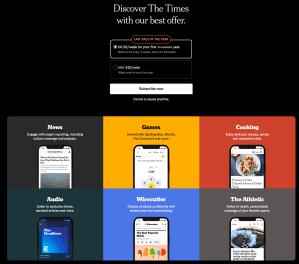
The New York Times does a great job of showcasing its value proposition to users who haven’t subscribed. It appeals to different interests and customers through its wide range of content. They can boast everything from News to The Athletic to Wirecutter.
After subscribing, users are offered a list of curated topics to personalise their experience. This makes the service more relevant and, by extension, helps keep users engaged.
Driving Referrals
The New York Times doesn’t stop at acquiring subscribers, though. They actively encourage word-of-mouth and referral tactics. In PLG, referrals are a powerful way to generate leads and attract new users. The New York Times leverages this effectively to expand its audience. As an example, The New York Times recently introduced a gift feature for existing subscribers to share content with non-subscribers.

This screen grab demonstrates how The New York Times taps into the emotional and seasonal theme of giving. There’s a clear call to action. This isn’t just about journalism. It’s about offering something for everyone, from “One-pot stews” to “Vexing Clues”. By highlighting its diverse verticals and offering personalised gift subscriptions, The New York Times allows its users to drive their marketing efforts.
However, there are some potential limitations:
- The lack of transparency around pricing may create hesitation for users, at least for me
- Whilst gifting can be rewarding, many users (myself included) might prefer additional incentives for referring others, such as discounts or perk
This is just me nitpicking, though.
Beyond gift subscriptions, The New York Times encourages referrals through features like sharing up to 10 free articles per month. These strategies not only drive user acquisition but also foster a sense of community. Sharing an article with a friend or family member sparks discussion and promotes knowledge sharing around a topic. Ultimately, this reinforces The New York Times’ core value proposition, which is quality journalism.
Key Takeaways
- Freemium access, like unlocked articles and teasers, attract users by showcasing value
- Personalisation through curated topics post-subscription boosts engagement and retention
- Behaviour analytics, such as articles read or subscription intent, can help optimise growth strategies
- Referrals, including shared articles and gift subscriptions, drive organic user acquisition
- The core value proposition (quality journalism) remains central
Final Words
PLG works. It works especially well because it’s able to capture real user needs and their jobs to be done. The New York Times exemplifies PLG principles, and they’ve done so really well.


Leave a comment